01
Generators
Surface
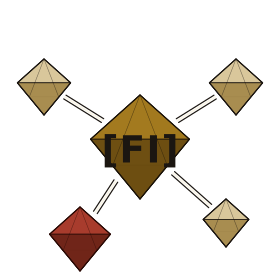
Read the full corpus — PubMed, bioRxiv, ChemRxiv — and surface candidate hypotheses optimized for originality and cross-domain synthesis. Their incentive is novelty. They are allowed to be wrong.
 Idea·Folding
A methodology · 2026
Idea Folding is an adversarial multi-agent reasoning methodology for scientific hypothesis generation. Generators surface candidates. Falsifiers attack them with the explicit job of finding fatal flaws. Arbiters score survivors on mechanistic plausibility, novelty, and experimental accessibility. A persistent failure log keeps dead branches dead.
The method
Multi-agent generation without adversarial structure degrades into confidence-weighted confabulation. A single rhetorically capable but factually wrong agent can overwhelm a group into false consensus — the documented persuasion cascade. The fix is not more agents; it's architectural isolation of roles and a persistent record of what has already been tried and killed.
# Idea Folding — core loop
while hypotheses_remain():
    candidates  = Generators(literature, open_questions)
    survivors   = Falsifiers(candidates)   # only job: find fatal flaws
    ranked      = Arbiters(survivors)       # isolated context window

    failures    = candidates - survivors
    failure_log.extend(failures)            # dead branches stay dead

    if meets_crystallization_threshold(ranked):
        yield ranked.top()                    # fold complete
The roles
Surface
Read the full corpus — PubMed, bioRxiv, ChemRxiv — and surface candidate hypotheses optimized for originality and cross-domain synthesis. Their incentive is novelty. They are allowed to be wrong.
Attack
Given a candidate, their only job is to find the fatal flaw. Contradictions with known biology. Experimental dead ends. Failed prior attempts buried in the literature. They are structurally incentivized to kill, not improve.
Score
Independent of both generators and falsifiers, arbiters score surviving hypotheses on mechanistic plausibility, novelty, and experimental accessibility. Separate context window. No awareness of the debate that produced the survivors.
Remember
Every hypothesis killed by the falsifiers is logged with the specific reason. Next cycle, generators can't re-surface the same dead branch without the failure log surfacing too. The system accumulates what it has already learned is false.
The precedent
In 2025, Google's AI co-scientist — a multi-agent generation-and-refinement system running on Gemini 2.0 — was pointed at human liver fibrosis. Out of more than 180,000 papers in the target domain, it surfaced Vorinostat, an FDA-approved HDAC inhibitor, as a candidate antifibrotic.
Before the AI surfaced it, just seven of those 180,000 papers had mentioned Vorinostat in the context of liver fibrosis. When tested in multi-lineage human hepatic organoids, Vorinostat reduced TGF-β-induced chromatin structural changes by 91% and promoted parenchymal regeneration. The mechanism — reversing the epigenetic lock on activated hepatic stellate cells — makes biological sense in retrospect, but no human had made the connection in time to test it.
That's the ceiling of unstructured multi-agent work. Idea Folding adds the failure log and the architecturally isolated arbiter — the two pieces the published architectures still lack — to keep the system from re-traversing dead branches and to prevent persuasion cascades from corrupting the survivors.
Engage
Idea Folding is the methodology inside Fibrex Institute — a research group targeting antifibrotic intervention in advanced decompensated cirrhosis. If you run a hepatology lab, a computational drug discovery group, or a liver organoid platform and the unmet need resonates, we want to talk.
If you're building an AI research pipeline for any underserved biomedical problem and you've hit the persuasion-cascade wall, the architecture here generalizes. Happy to share what's working and what isn't.
Three paragraphs. Who, what you're working on, where the overlap is.